[COLUMN] Spider-Noir Understands the Original, Golden Age Appeal of Superheroes | by Darren Mooney
![[COLUMN] Spider-Noir Understands the Original, Golden Age Appeal of Superheroes | by Darren Mooney](https://bakemono.app/data/92/66/9266e4de1ef80876e725542245db58fdcf8722e0e0dca24e30085e4fe1f27852.jpg?f=noir-1.jpg)
Note: This piece talks fairly broadly about the plot of Spider-Noir, the new streaming Spider-Man show on Prime Video. All eight episodes are streaming now. There is a fairly big spoiler for the fifth episode in here, but otherwise a lot of it is fairly safe. If you’re looking for a quick review, I had a good time with it. It is, like a lot of eight-episode streaming shows, about two to three episodes too long and it suffers a little bit from being very obvious in its homages, but it’s also just a really good time anchored in a set of really fun performances, some great production and a genuine thoughtfulness about superheroes.
On the surface, Spider-Noir is an inherently nostalgic premise. It is a spin-off from Spider-Man: Into the Spider-Verse following superhero-turned-private-eye Ben Reilly (Nicolas Cage) in a version 1930s New York that throws the wall-crawling wonder against crime boss Finn O’Brien (Brendan Gleeson), better known as Silverman.
It is transparently a love letter to film noir. Early in the season, Reilly takes a trip to the cinema to catch the James Cagney vehicle Great Guy. A few episodes later, he explains to his love interest Felicia “Cat” Hardy (Li Jun Li) that he was so transformed by the bite that made him a superhero that he “had to learn how to be more human again. Believe it or not, I went to the movies, I watched the actors. I studied the way they spoke, the way they moved.”
This is very much reflected in Cage’s performance. When asking young newspaper boy Frankie (Cary Christopher) to impersonate him, Reilly advises, “So, I want you to be me. You know, like one of those guys in the movies. You know, Bogey, Cagney, Eddie G? You know, you can wear a hat, you can smoke a cigarette. You’re cool.” Cage gets to spend a significant amount of screentime going “… see?”, as if he wandered off of a 1930s movie set.
The show even seems to cast Jack Huston as a disfigured First World War veteran who returns home to work for the mob in what feels like a very blatant homage to Huston’s wonderful work as Richard Harrow on the underrated Boardwalk Empire. Casting Li Jun Li as a nightclub performer may also allude to the actor’s most high-profile previous roles, playing cabaret singer Lady Fay Zhu in 1930s Los Angeles in Babylon and playing businesswoman Grace Chow in 1930s Mississippi in Sinners.
Indeed, arguably the biggest issues with Spider-Noir, most obviously a predictable plot that signposts a number of its big twists involving Hardy several episodes in advance, are rooted in that sincere affection for the history of film noir. Of course the opening case, in which Ben is tasked with snapping photos of Hardy’s alleged infidelity by her alleged husband (Brian Howe), turns out to be a set-up, in homage to Chinatown. Of course Hardy betrays Ben in the episode helpfully titled “Betrayal.”
However, the pastiche is so affectionate and sincere that it’s hard to get too bent out of shape by these minor flaws. Indeed, Spider-Noir is so deeply in love with the films that it is emulating that has been made available to stream in two formats, “True-Hue Full Color and Authentic Black & White.” The screeners provided to critics came with a request that they watch at least one of the episodes in either format, and both formats have something to recommend them.
All that said, what is really interesting about Spider-Noir is that, despite its retro setting and tone, the show is very engaged with both the current moment and the superhero genre’s relationship to that moment. This is a show set at some vague point in a fantastical version of the 1930s, one where Prohibition is seemingly still in effect well into the decade. However, it understands that this setting has a certain contemporary resonance.
Spider-Noir begins with Ben Reilly having retired from superheroism. “I used to be the Spider,” he narrates. “This city’s hero. Always on guard, always ready to swoop in and save the day.” He relates the story of the death of his lover, Ruby J. Williams (Amanda Schull), explaining that it broke him, “After that, I didn’t want the power or the responsibility. So I went back to being just an ordinary man. That was five years ago.”
There are, of course, pragmatic reasons why Spider-Noir might decide to begin after the end of Ben Reilly’s superhero career. Nicolas Cage is 62 years old. He is not exactly Tom Holland or Andrew Garfield. Cage was being considered to play superheroes in the 1990s, and he got to play one in the 2000s. It might be too much to buy Cage as a character at the start of his career. Even more than that, it’s a choice that helps keep the budget of an eight-episode miniseries under control.
However, it also feels pointed. One can debate the exact causes of “superhero fatigue”, mainstream audiences’ increasing disengagement from a genre that was a license to print money about a decade ago, but it is a real phenomenon. This year’s The Devil Wears Prada 2 has grossed more than any of the Marvel movies released last year. Soon enough, it will have grossed more than any superhero film of 2025. No wonder Marvel referenced “superhero fatigue” while advertising Wonder Man.
There is a sense watching Spider-Noir that the age of heroes is over, in a manner not entirely dissimilar to the general mood of James Mangold’s Logan. Certainly, Ben seems disillusioned with both himself and his former career. Ben repeatedly classifies himself as “a coward.” He admits that his superhero career was never motivated by the greater good, but by self-aggrandisement. “Spider was never a hero,” he confesses. “I only did it for the thrill.”
This feels like a somewhat clear-eyed commentary on the state of much of the modern superhero genre, which often devolved into vapid empty power fantasies. The mainline Spider-Man franchise included a film in which Peter Parker (Tom Holland) was gifted a fleet of killer drones by Tony Stark (Robert Downey Jr.), and when Peter rightly wondered whether it was appropriate for a teenager to hold that sort of power, his self-doubt was exploited by the villainous Mysterio (Jake Gyllenhaal).
There is a real sense that the modern superhero genre, at least within the major franchises, has failed to meet the moment. The recent season of Daredevil: Born Again ended with Daredevil (Charlie Cox) effectively forgiving the businessman-turned-politician Wilson Fisk (Vincent D’Onofrio) for turning New York into an authoritarian dictatorship and effectively letting him walk away Scot-free to return in the next season. Captain America: Brave New World imagined that platitudes might convince a renegade president-turned-rage monster (Harrison Ford) to see reason.
More broadly, Spider-Noir is in conversation with other tropes at play in modern superhero cinema, particularly the tendency to think of superheroes as soldiers or extensions of the military-industrial complex. Spider-Noir is also built around a generation of superpowered individuals who were the product of “some sort of failed super soldier program.” Ben is decided disinterested in this framing of superheroes. “I’m sorry, are we boring you?” asks Janet (Karen Rodriguez), his receptionist.
Ben replies, simply, “The war ended 15 years ago.” It is not relevant. Later, Ben encounters the mysterious Doctor Faber (Amy Aquino), who is trying to treat those affected. Ben likens her to the military doctors who experimented on him. “Don’t you dare confuse me with them,” she protests. “Those scientists only cared about war. They took one look at you and they were just like the Germans. They wanted to use you as weapons. I am trying to do the opposite.”
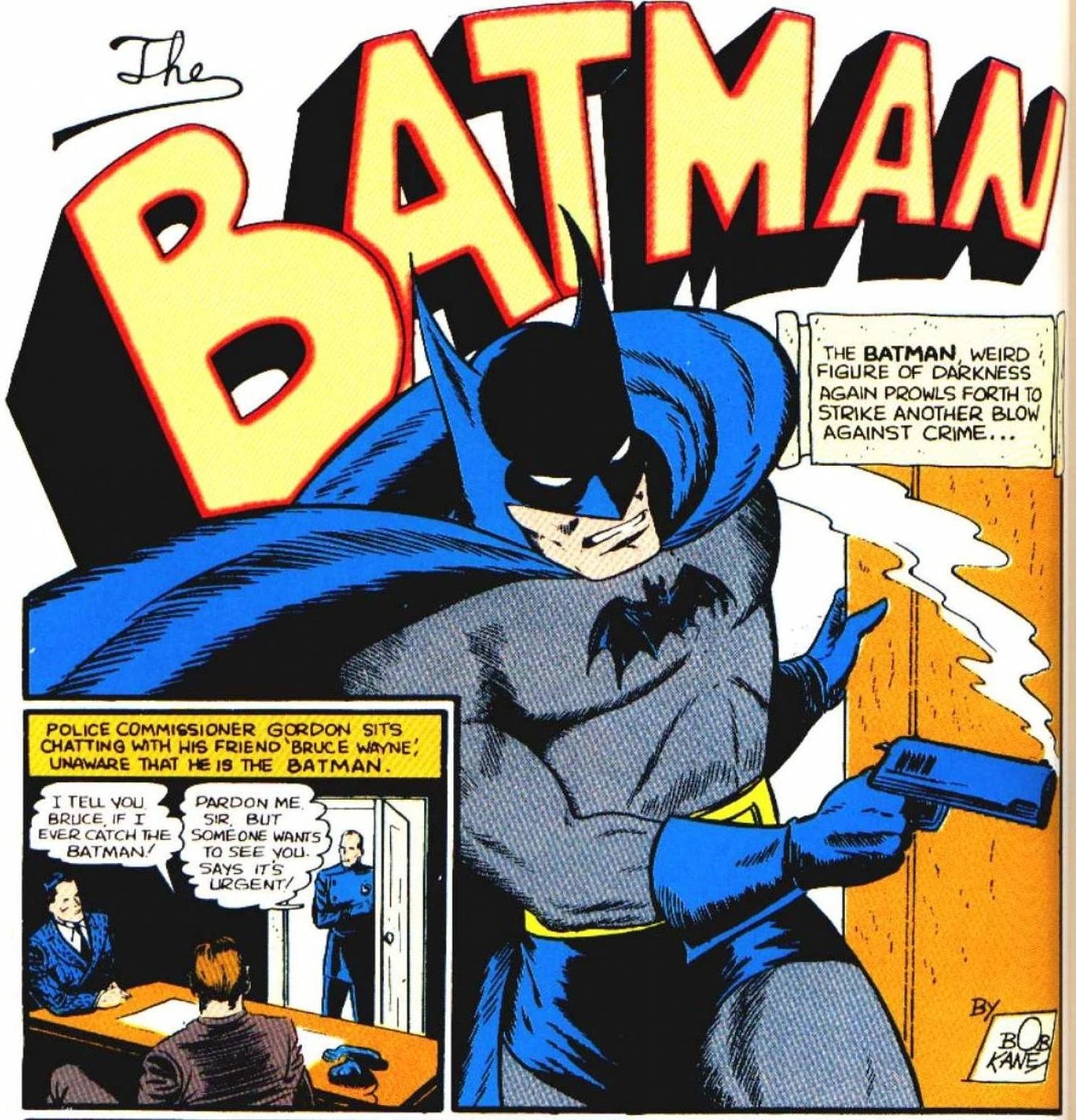
Spider-Noir sidesteps all of the baggage of the modern superhero. It takes the concept back to its origins. The superhero archetype emerged during the 1930s. If the character template was not created by Superman, it was certainly codified by him. This was the decade that produced pulp icons like the Phantom, the Spirit and the Shadow, who paved the way for the more conventional superheroes. Batman, who used a pistol in his early appearances, also straddled that line.
The opening episode finds Riley and fellow gumshoe Donegal (Cameron Britton) tracking down the missing Jimmy Addison (Jack Mikesell). When the pair track him to a Standard Oil Depot on the docks, they discover Addison has been transformed into something more than human. He has been granted superpowers. He can control flame in a manner that evokes the Human Torch, the first superhero created by Timely, the comics company that would become Marvel.
However, despite drawing from this larger historical context, Spider-Noir remains engaged with the present. In the absence of the Spider, crime has flourished in New York, with Silvermane taking control of crime in the city. As with the casting of Huston and Li, the use of Brendan Gleeson seems quite deliberate here. Gleeson made quite an impression for being one of the first actors to play Donald Trump, another New York fixture, in a serious work about his presidency, The Comey Rule.
Even beyond its portrayal of a New York titan who rules through corruption, the 1930s setting resonates with the modern world. Ben Reilly is navigating an American that is just recovering from a protracted foreign intervention, unable to care for the veterans of that conflict. There is massive income inequality, with Silvermane ruling over New York from his lavish penthouse while those less fortunate live in homeless encampments known as “Hoovervilles.”
This was the cultural climate that produced superheroes. In his earliest stories, Superman fought for the common man against war profiteers, slum lords and the prison-industrial complex. Over years, despite efforts from writers like Grant Morrison, the superhero has lost sight of that facet of the archetype, forgetting that superheroes work better as empowerment fantasies, as heroes standing up for those with less power and influence.


In the show’s second episode, Silvermane ruminates on the state of the world with Ben, the feeling that everything is starting to unravel and come undone. “You know what entropy is, Reilly?” Silvermane asks. “Universe trends to disorder. Can’t help itself. All you can do is fight to keep the chaos from your door.” It’s a thought that has obvious contemporary resonance in an era where it feels like all social and moral norms are breaking down, and nobody is doing anything to stop it.
In other words, Spider-Noir understands what it means to live in a world without heroes, where decent men like Ben Reilly are willing to sit back and do nothing as democracy decays and crumbles around them. After all, it’s easy to do nothing. As Ben observes, “With no power comes no responsibility.” However, that also means that Spider-Noir also understands the appeal and the necessity of belief in heroes.
In some ways, Spider-Noir feels like it is part of a larger push to take superheroes back to their roots in order to meet the challenges of the moment. The Ultimate line at Marvel and the Absolute universe at DC have enjoyed great success by taking iconic superheroes and reworking to speak to the current moment in the same way that the Golden Age pulp heroes did.
Scott Snyder and Nick Dragotta’s Absolute Batman reimagines Bruce Wayne as a working class hero fighting an evil oligarchy. Jason Aaron and Rafa Sandoval’s Absolute Superman finds the Last Son of Krypton standing up for migrant workers. Deniz Camp and Juan Frigeri’s Ultimates reconfigures the iconic superhero team as the spearheads of a revolution against a broken system. These reconceptualizations of these beloved characters resonate with audiences because they speak to this moment the same way their predecessors did to earlier generations.
Spider-Noir understands the value of superheroes, in the hope that an individual might find the proportional strength of a spider to stand up for those who can’t.